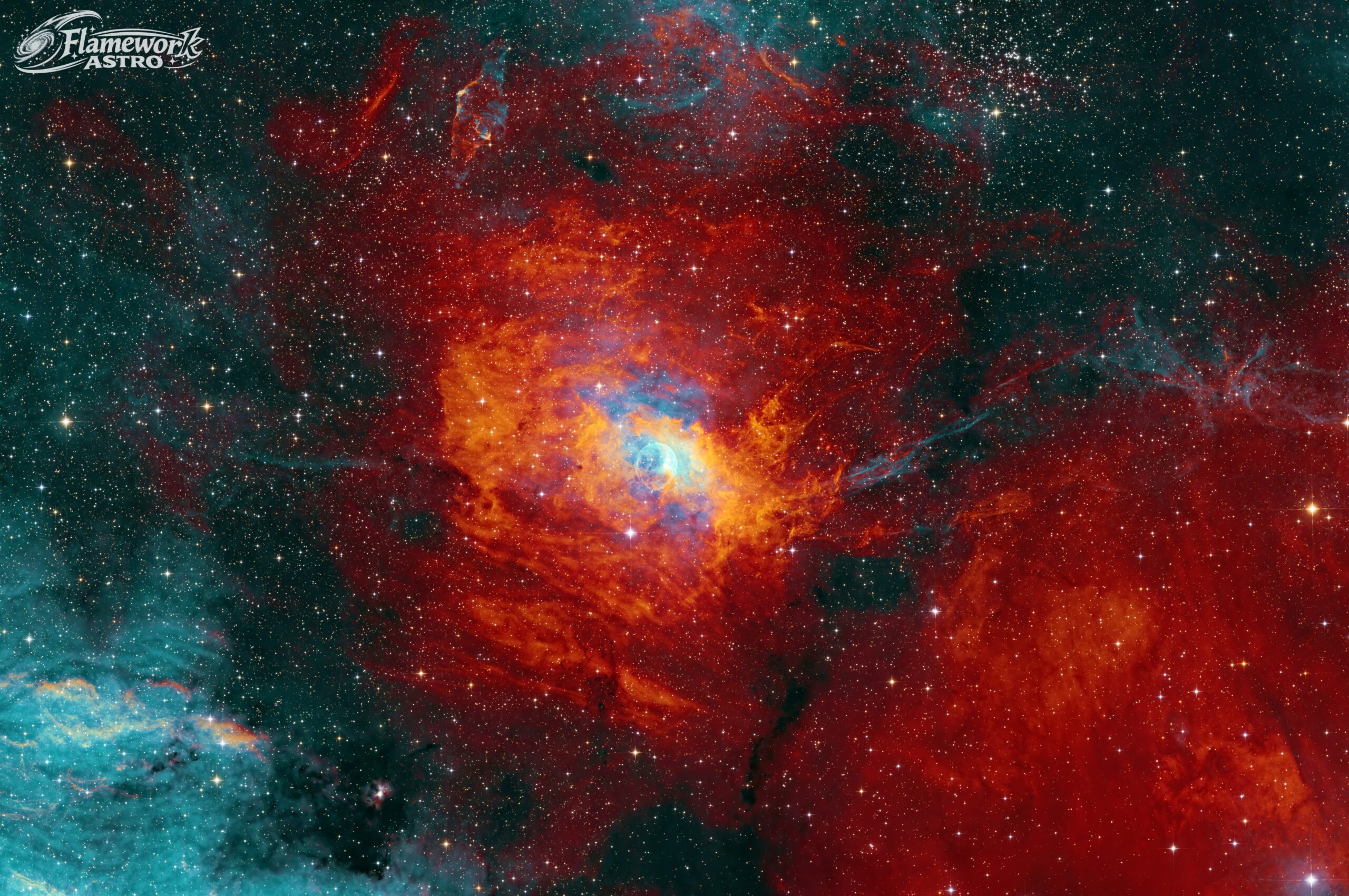
The Bubble Nebula (NGC 7635)
in a Rich Emission Field
NGC 7635, better known as the Bubble Nebula, lies in the constellation Cassiopeia at a distance of roughly 7,100 light-years. Its distinctive shell is shaped by the powerful stellar wind of a hot, massive star, which pushes into the surrounding interstellar material and creates the remarkably well-defined bubble that gives the nebula its name.
What makes this field particularly interesting, however, is that the Bubble itself is only one part of a much richer scene. The frame also includes the open cluster M52, the planetary nebula PK 112-00.1, part of Sh2-161, and the edge of the Lobster Claw Nebula (Sh2-157). Together with the widespread emission nebulosity, dark structures and dense star fields, these objects reveal just how complex this region of Cassiopeia is. The presence of M52, Sh2-161, Sh2-157 and PK 112-00.1 in wider views of this region is independently documented in astronomical imaging references.
The final image is based on a total of 51 hours and 45 minutes of narrowband exposure, captured through Hα, OIII and SII filters.
Most of the data for this project was collected between September and mid-October 2026, mainly from the rooftop of the apartment building where I live in Békásmegyer, Budapest. This is a Bortle 8, heavily light-polluted urban sky, far from ideal for deep-sky imaging. With narrowband filters and enough integration time, however, even under these conditions a surprising amount of faint nebulosity can still be revealed.
Rather than using a traditional SHO / Hubble Palette combination, I processed the image around an HOO base created from the hydrogen-alpha and oxygen data. The SII signal was then colourised into a warm golden tone and blended over the HOO image using a Screen blend. This technique is often referred to as SII gilding: instead of assigning sulphur to a conventional RGB channel, it is used as an additional coloured layer that selectively enhances sulphur-rich structures while preserving the underlying HOO character.
After more than fifty hours of integration, the Bubble Nebula itself almost becomes a detail within the much larger emission landscape surrounding it. For me, that broader context — from the Bubble and M52 to the fainter nebulae scattered across the frame — is what makes this field especially fascinating.